
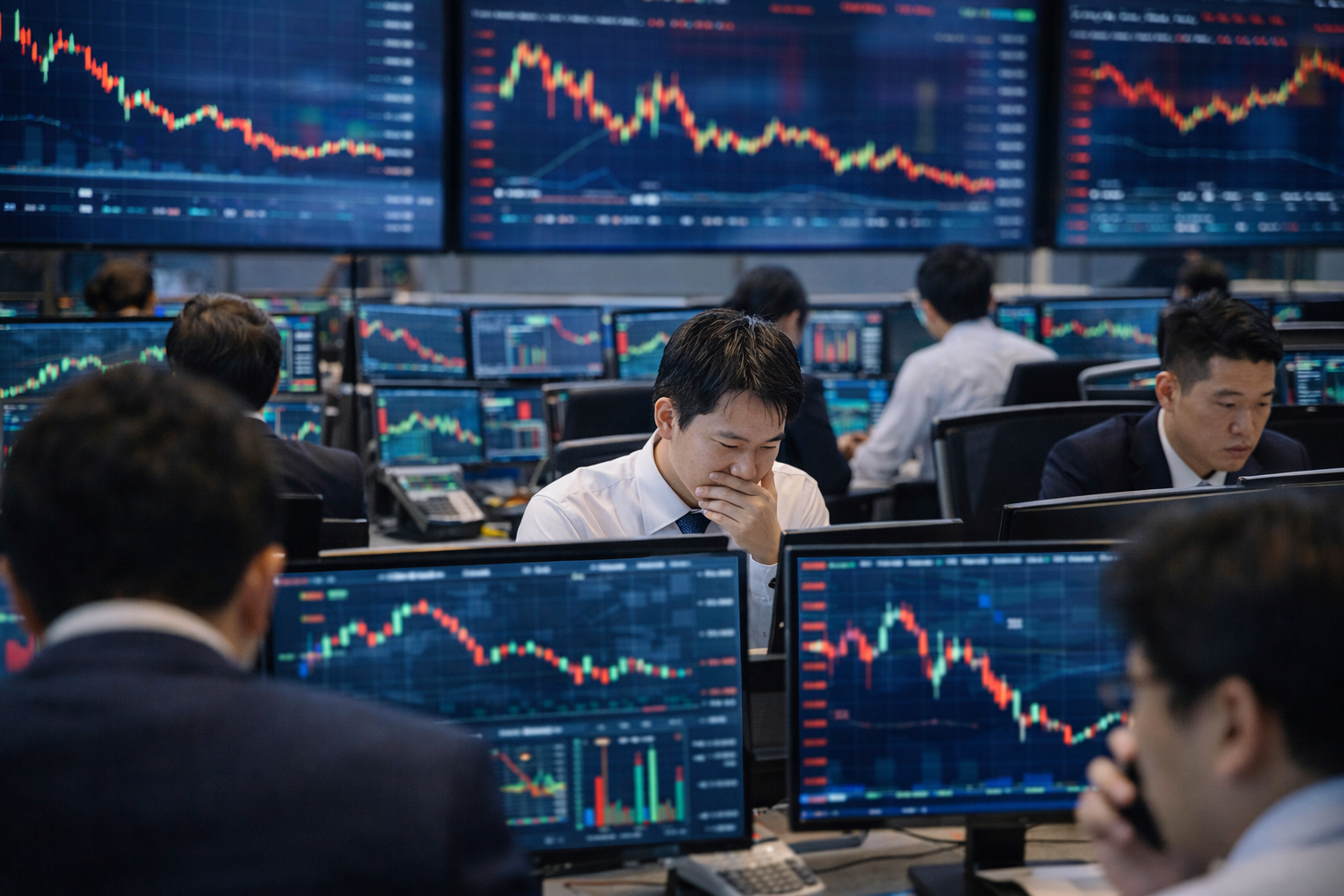
Asian stocks diverged on Wednesday as South Korea’s KOSPI extended its retreat while Japan’s Nikkei 225 held close to 70,700, showing how differently the region’s two chip-heavy markets are absorbing high US yields, firm oil and stretched AI valuations.
The KOSPI fell 1.16% to 6,860.73 by 11:20 am in Seoul as foreign investors sold a net 1.16 trillion won of shares and institutions also turned sellers.
SK Hynix dropped 2.09% and Samsung Electronics slipped 0.28%. In Tokyo, the Nikkei was roughly flat at 70,685.22, with machinery and industrial names offsetting weakness in financial shares.
KOSPI takes the heavier hit as foreign selling persists
The pressure in Seoul is increasingly concentrated around the stocks that powered the first half of the year’s AI rally.
Samsung and SK Hynix remain the KOSPI’s dominant earnings drivers, but foreign investors have repeatedly used strength to reduce exposure as US long-term yields hover near multi-decade highs.
The won also weakened to 1,341.35 per dollar on Wednesday, another sign that overseas investors remain cautious.
Samsung’s preliminary third-quarter results on Thursday are therefore a critical test. Analysts expect a sharp year-on-year profit increase, but the market is increasingly focused on whether memory margins have peaked and whether HBM pricing can stay strong.
Goldman Sachs analyst Heather Oh said in a report cited by Maeil Business Newspaper that Samsung could face extra volatility around the earnings release because ETF rebalancing, options expiry and the end of its share buyback programme are converging.
She also identified a return of foreign buying as important for a more durable recovery.
Nikkei holds 70,000 but rates still cap the upside
Japan is holding up better. The Nikkei was near flat after closing above 70,000 on Tuesday, while the broader Topix rose 0.4%.
Hitachi gained 2.4% and Mitsubishi Heavy Industries added 2.5%, helping offset losses in banks such as Resona Holdings. The yen remained weak near 158.4 per dollar, still providing some support to exporters.
The bigger question is valuation. Business Insider Japan cited Rakuten Securities senior market analyst Masayuki Doshida as warning that higher interest rates reduce the earnings multiple investors are willing to pay.
His estimates suggest the Nikkei’s move back above 70,000 leaves less room for further multiple expansion unless earnings forecasts rise again.
That tension is becoming more important as Japan’s 10-year government bond yield remains around 3%, far above levels investors were accustomed to during the earlier rally.
Oil and US yields keep Asia’s risk premium elevated
The broader regional backdrop was softer. MSCI’s Asia-Pacific index outside Japan fell about 0.3%, Hong Kong’s Hang Seng lost around 0.6% and Australian shares were little changed.
Mainland Chinese markets remained closed for holidays.
Brent rose about 1% to $101.65 a barrel and WTI climbed to $90.38 as traders weighed a Gulf of Mexico storm and renewed Houthi-Saudi tensions against improving Middle East exports.
US Treasury yields remain the bigger cross-market constraint.
The 10-year yield was around 5.31% and the 30-year near 5.67%, keeping discount-rate pressure on expensive technology shares. Fed minutes due later Wednesday could shift expectations again.
The post KOSPI keeps sliding while Nikkei holds 70,000: why Korea is taking the bigger hit appeared first on Invezz