
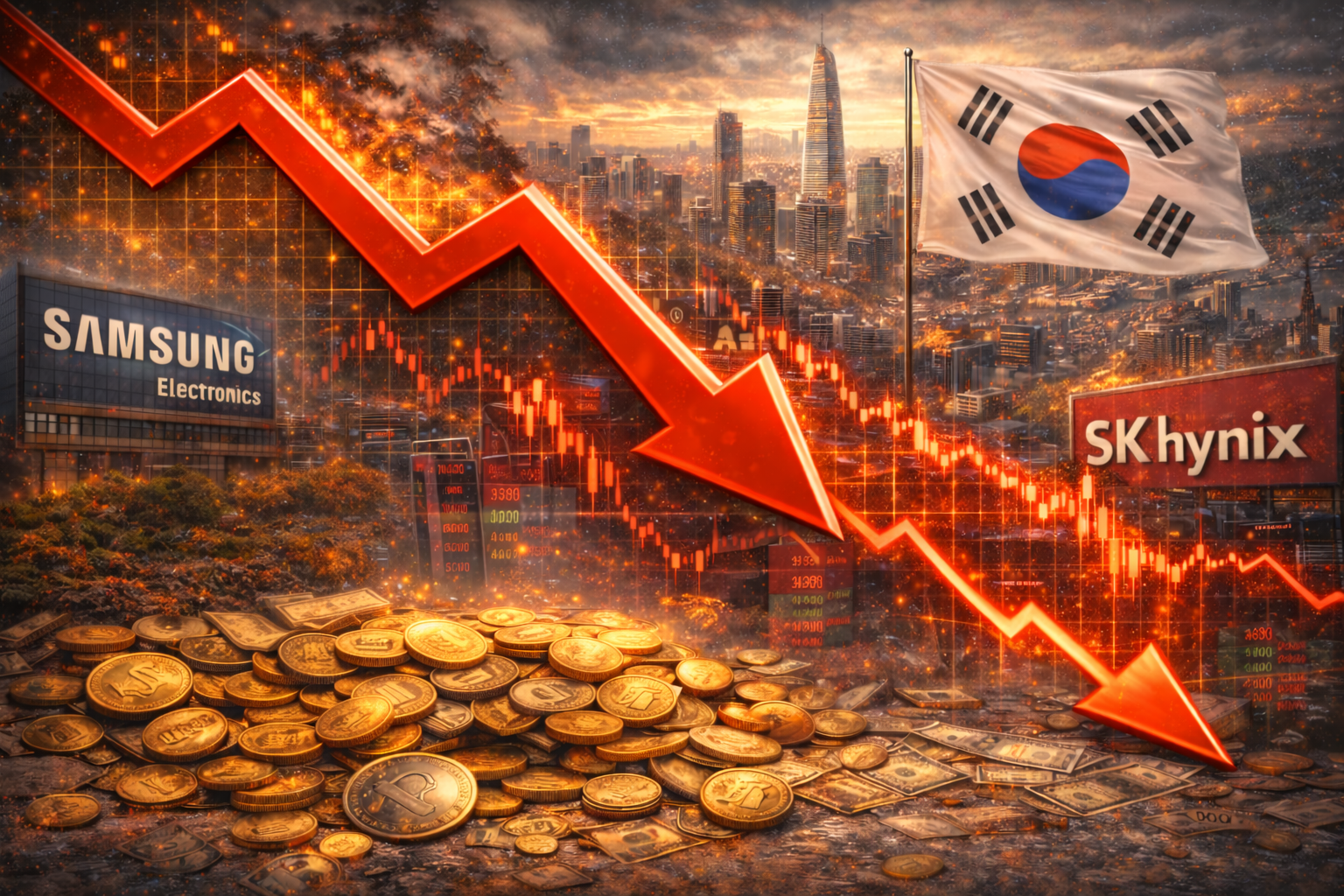
South Korean equities slumped on Monday, leading declines across Asian markets, as uncertainty over interest rates and fresh doubts about the sustainability of artificial intelligence-related spending weighed heavily on technology shares.
The benchmark Kospi fell as much as 5%, its steepest intraday decline since Nov. 5, prompting authorities to temporarily halt trading, according to an official note.
Heavyweight chipmakers Samsung Electronics and SK Hynix each fell more than 5%, erasing part of the gains that had driven the market to outperform global peers over the past year.
The Korean won also weakened sharply, adding to the risk-off tone.
AI trade under pressure
A combination of global and sector-specific factors prompted investors to unwind positions in previously high-flying names.
Market sentiment was dented by lingering uncertainty surrounding Kevin Warsh’s nomination as the next Federal Reserve chair, alongside volatility in precious metals that has rippled across risk assets.
Technology shares came under additional pressure after comments from Jensen Huang, chief executive officer of Nvidia, who said a proposed $100 billion investment in OpenAI was “never a commitment.”
The remarks raised fresh questions about the scale and pace of future capital spending tied to artificial intelligence, a key driver of equity gains in South Korea.
“Jensen’s comments likely had a near-term sentiment impact, particularly on AI-exposed names that have rallied strongly year to date,” said Gary Tan, a portfolio manager at Allspring Global Investments, in a Bloomberg report. “The remarks primarily served as a profit-taking catalyst, as we see some unwinding of crowded trades across the market.”
From global leader to sharp reversal
Seoul has been among the world’s strongest equity markets since last year, buoyed by voracious global demand for memory chips used alongside AI processors.
That surge lifted South Korea’s total equity market valuation above $3.3 trillion, allowing it to overtake Germany last week as the world’s 10th-largest stock market, just behind Taiwan.
Monday’s selloff marked a sharp reversal of that momentum.
Domestic and foreign institutional investors were net sellers of Korean shares, while retail investors stepped in as buyers, according to market data.
The pullback in Seoul mirrored broader weakness across the region, with the MSCI Asia Pacific Index falling more than 2%.
Currency slide
Pressure was also evident in currency markets.
The Korean won fell as much as 1.3% to 1,459.20 per dollar, its largest daily decline since October, underperforming most Asian peers amid foreign outflows from equities.
Asia-Pacific markets declined on Monday as investors digested private data on China’s factory activity for January, while gold prices extended their losses from the previous session.
The sharp declines underscored how quickly sentiment can turn in markets that had been heavily positioned for continued gains from the global AI boom, as investors reassess both monetary policy risks and the durability of technology spending.
The post South Korean stocks tumble as AI doubts and rate jitters trigger sharp selloff appeared first on Invezz