
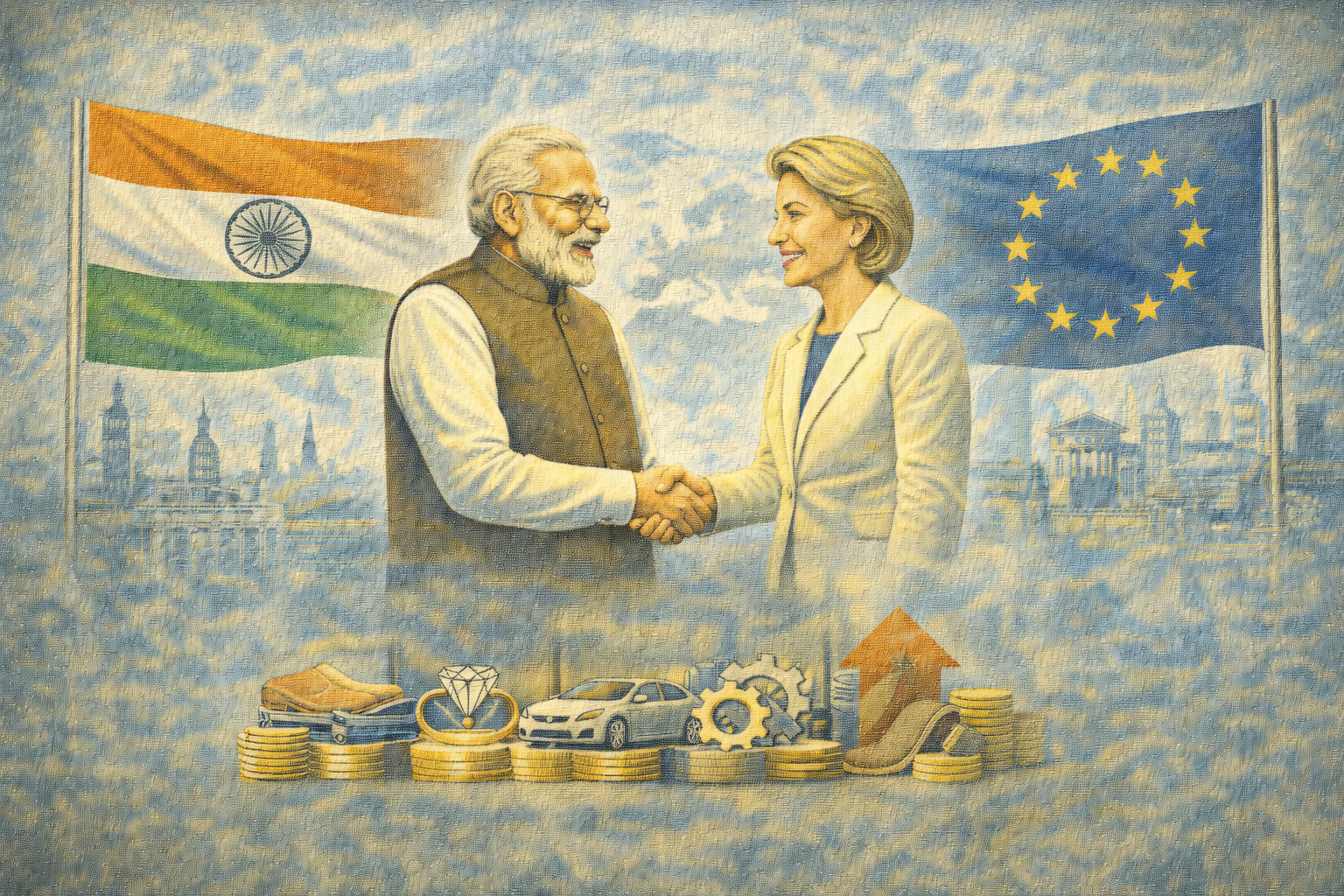
India and the European Union have concluded a long-awaited free trade agreement, says Indian Prime Minister Narendra Modi, marking a significant shift in global trade ties as both sides seek to hedge against growing geopolitical and tariff-related uncertainty linked to the United States.
Modi described the pact as a “landmark” agreement and “the mother of all deals” during a speech at India Energy Week on Tuesday.
The agreement follows nearly two decades of intermittent negotiations and is expected to create one of the world’s largest free trade areas.
A trade bloc spanning a quarter of the global economy
The India–EU free trade agreement represents about 25% of global GDP and roughly one-third of global trade, according to Modi.
“Yesterday, a big agreement was signed between the European Union and India,” he said.
“People around the world are calling this the mother of all deals. This agreement will bring major opportunities for the 1.4 billion people of India and the millions of people in Europe.”
The deal is expected to forge a combined market of around 2 billion people at a time when global trade relationships are under strain.
Modi said the agreement would be particularly supportive of Indian sectors such as textiles, gems and jewelry, leather, and footwear.
“I congratulate our colleagues associated with every sector, such as textiles, gems and Jewelry, leather and shoes. This deal will prove to be very supportive to these sectors,” he said.
European Commission President Ursula von der Leyen confirmed the agreement on Tuesday, describing it as a historic milestone in EU–India relations.
“Europe and India are making history today. We have concluded the mother of all deals. We have created a free trade zone of two billion people, with both sides set to benefit,” von der Leyen said in a post on social media platform X.
Europe and India are making history today.
We have concluded the mother of all deals.
We have created a free trade zone of two billion people, with both sides set to benefit.
This is only the beginning.
We will grow our strategic relationship to be even stronger.
Modi and Ursula von der Leyen are expected to issue a joint statement later Tuesday at the India–EU summit in New Delhi, outlining the details of the agreement.
The formal signing is expected to take place after a legal vetting process lasting five to six months, with implementation targeted within a year, according to an Indian government official, said a Reuters report.
Strategic hedge as US trade ties fray
The agreement comes at a time when both India and the EU are recalibrating trade strategies amid strained relations with Washington.
President Donald Trump has imposed a 50% tariff on Indian goods since August last year, and an India–US trade deal collapsed after a breakdown in communication between the two governments.
For New Delhi, the pact with the EU could provide an alternative export outlet as it absorbs the impact of US tariffs.
Since August, India has signed trade agreements with the UK, Oman, and New Zealand, making this its fourth major deal in a short period.
The EU has also accelerated trade diplomacy.
The India agreement follows a recent pact with the South American bloc Mercosur, and earlier deals with Indonesia, Mexico, and Switzerland, underscoring efforts to diversify trade partnerships.
Trade flows highlight scale and limits of the deal
According to European Commission data, goods trade between India and the EU exceeded €120 billion in 2024, making the bloc India’s largest trading partner.
Trade stood at $136.5 billion in the fiscal year through March 2025.
India’s main exports to the EU include machinery and appliances, chemicals, base metals, mineral products, and textiles, while the EU exports machinery, transport equipment, and chemicals to India.
The agreement is expected to double EU goods exports to India by 2032, with New Delhi eliminating or cutting tariffs on 96.6% of EU exports, according to the European Commission.
Covered products include automobiles, industrial goods, wine, chocolates, and pasta.
In return, the EU will phase out or reduce tariffs on 99.5% of imports from India over seven years, India’s Ministry of Commerce and Industry said.
It is India’s most ambitious trade pact to date.
The deal allows up to 250,000 European-made vehicles to enter India at preferential duty rates—more than six times the quota in recent agreements, Bloomberg reported.
Tariffs on premium European wine will be reduced to 20% from 150% on a phased basis, according to Commission documents.
The agreement is also expected to boost India’s exports of labor-intensive goods such as apparel, gems and jewelry, and footwear, sectors affected by higher US tariffs under President Donald Trump.
The EU has offered binding commitments on student mobility and post-study visas, along with market access across 144 services sectors.
Dairy products are excluded from the deal.
Despite the scale of the deal, experts caution that it will not replace the importance of US trade ties.
In 2024, India’s goods trade surplus with the US was $45.8 billion, compared with $25.8 billion with the EU.
India is also only the EU’s ninth-largest trading partner, accounting for 2.4% of the bloc’s total goods trade.
Still, von der Leyen said in Davos last month that the EU is choosing “fair trade over tariffs. Partnership over isolation. Sustainability over exploitation,” a sentiment now reflected in the agreement with India.
The post India-EU complete trade deal covering 25% of global GDP, says Modi appeared first on Invezz