
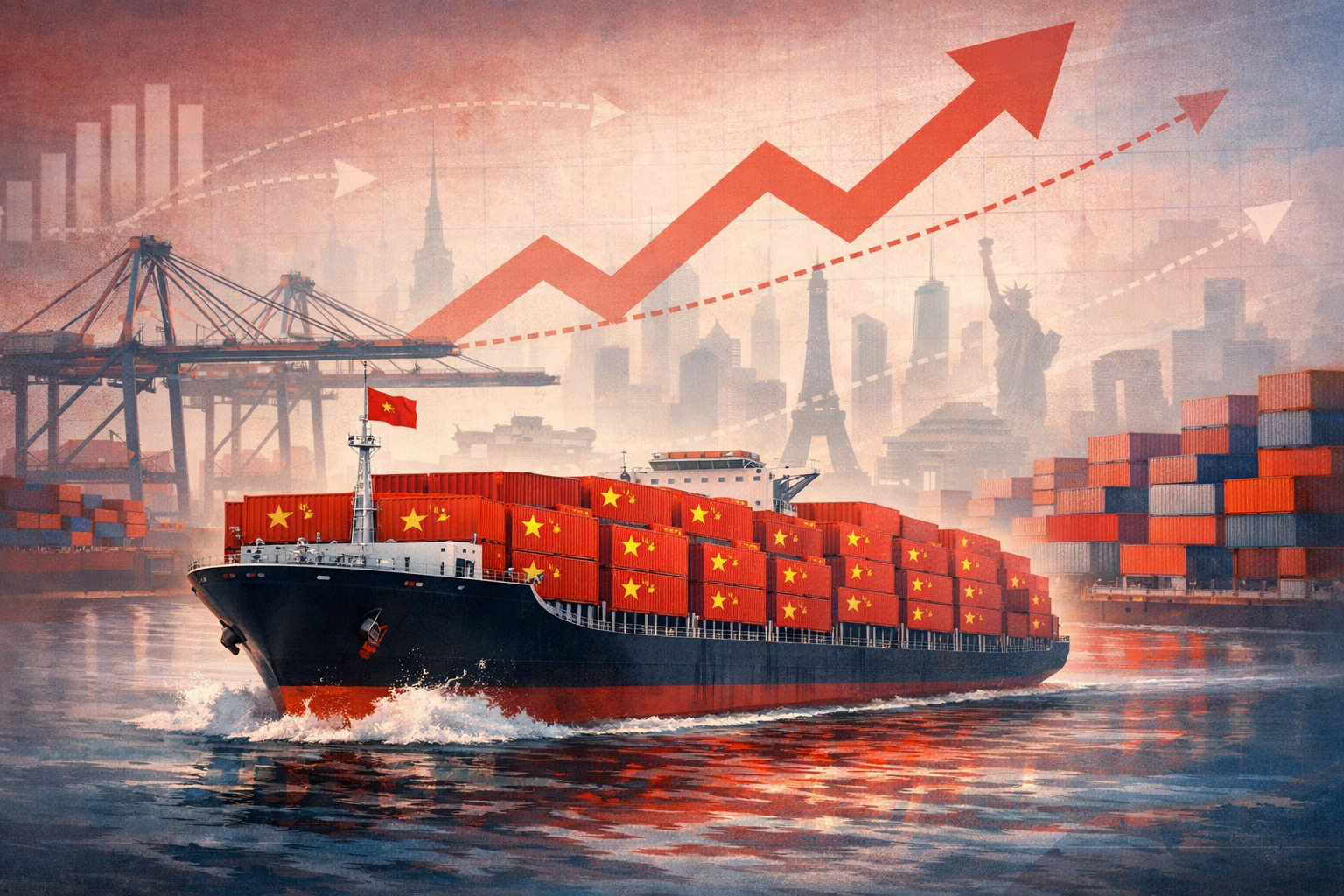
China’s export growth in December sharply exceeded market expectations, helping push the country’s annual trade surplus to a record $1.19 trillion in 2025, even as imports rebounded at their fastest pace in three months.
The data underscored the resilience of China’s manufacturing sector amid lingering domestic weakness and ongoing, though easing, trade tensions with the United States.
Customs figures released Wednesday showed exports rose 6.6% in US dollar terms in December from a year earlier, beating analysts’ median estimate of 3% and accelerating from a 5.9% increase in November.
Imports climbed 5.7% year-on-year, far surpassing expectations of 0.9% growth and marking the strongest expansion since September, according to LSEG data.
For the full year, China’s exports grew 5.5% compared with 2024, while imports were flat, resulting in the largest trade surplus ever recorded by the world’s second-largest economy.
December trade data signals external strength
In monthly terms, China’s trade surplus reached $114.14 billion in December, above economists’ expectations of $109.6 billion.
Export growth in yuan terms stood at 5.2% year-on-year, while imports rose 4.4%, highlighting broad-based momentum despite currency effects.
China’s recent export strength has been reflected in forward-looking indicators.
Economists at Morgan Stanley noted that export momentum “has remained robust,” citing the export-orders index in an official manufacturing survey and weekly container shipment data.
Imports rebounded strongly after contracting in November, suggesting some stabilization in demand for foreign goods.
However, the full-year picture remained uneven, with imports flat in 2025 compared with growth of 1.1% the previous year.
Trade tensions and shifting export destinations
Despite the strong headline figures, China’s trade relationship with the United States remained strained for much of last year.
Trade tensions led to double-digit declines in Chinese shipments to the US for most of the year, according to the data.
Exporters instead ramped up shipments to non-US markets, contributing to a widening trade imbalance that has drawn scrutiny from major trading partners, including the European Union.
In October, China and the US agreed to roll back a series of export-control measures and higher tariffs under a one-year trade truce, following talks between President Xi Jinping and US President Donald Trump.
The détente has eased some external pressure, though questions remain about how durable the improvement will be.
Policy outlook and growth expectations
International institutions have continued to urge China to rebalance its growth model.
In December, International Monetary Fund Managing Director Kristalina Georgieva called on Beijing to shift away from export-led growth and boost domestic consumption.
Chinese officials have pledged to expand imports and work toward a more balanced trade structure.
Zhiwei Zhang, president and chief economist at Pinpoint Asset Management, said strong exports could allow policymakers to hold steady in the near term.
He expects Beijing “to keep the macro policy stance unchanged at least in the first quarter, as strong export growth helps mitigate soft domestic demand and trade tensions with the US have eased.”
Looking ahead, economists largely expect exports to remain a key growth driver. “We continue to expect exports to act as a big growth driver in 2026,” said Jacqueline Rong, chief China economist at BNP Paribas.
China is set to release its fourth-quarter and full-year GDP data next Monday.
Economists polled by Reuters expect the economy to have expanded 4.5% in the final quarter, with Beijing targeting growth of around 5% in 2025, even as deflationary pressures and a deepening property downturn continue to weigh on domestic demand.
The post China’s exports beat forecasts, driving record $1.2T trade surplus in 2025 appeared first on Invezz