
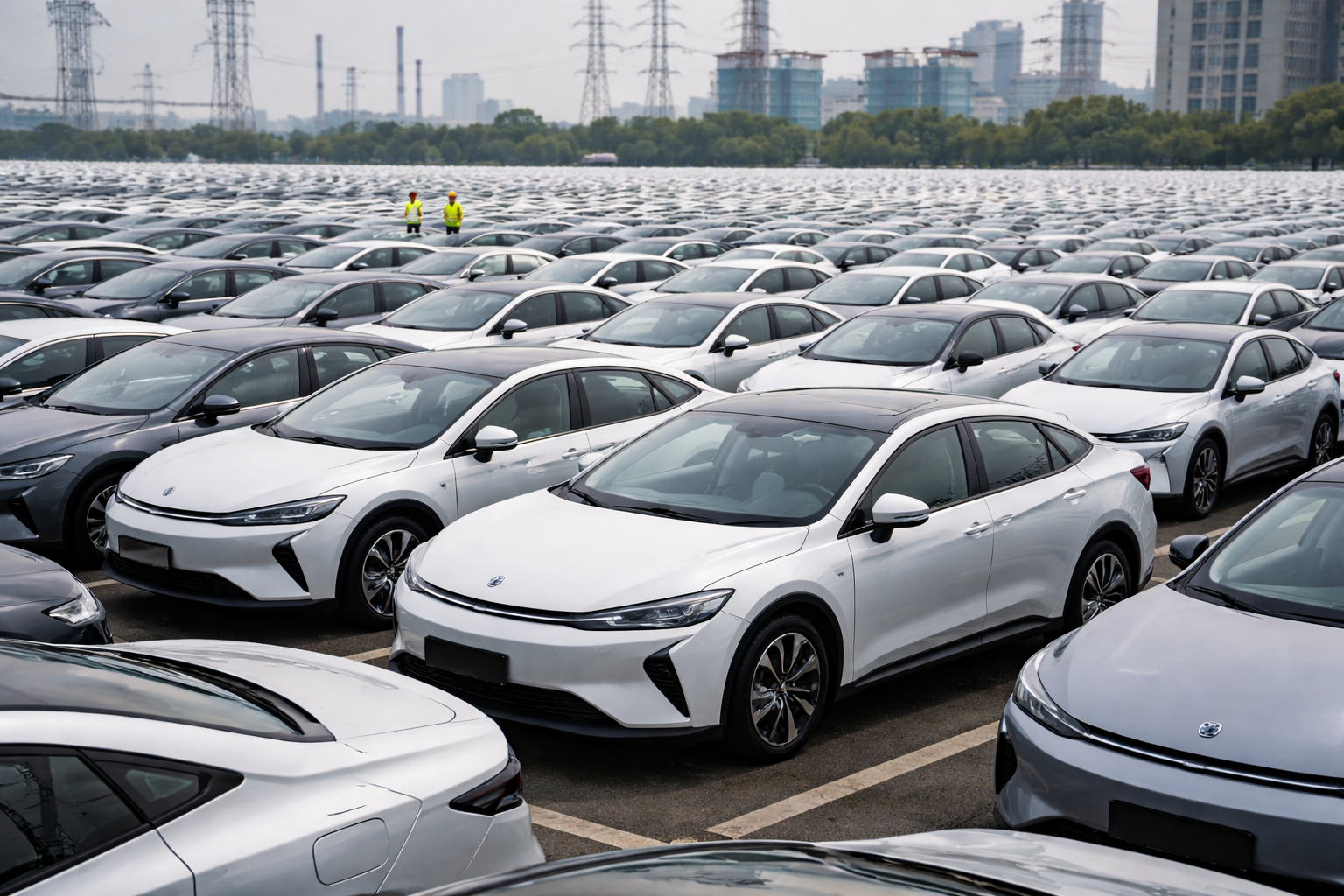
After years of explosive growth, China’s electric-vehicle industry is entering a more complex and uncertain phase.
Domestic demand is cooling, competition is intensifying and policymakers are recalibrating incentives, even as Chinese carmakers push aggressively into foreign markets to sustain momentum.
The shift marks a turning point for the world’s largest EV ecosystem, which has been built on generous subsidies, rapid technological advances and an expanding middle class.
Recent data suggest that the industry is no longer in a straight-line expansion but is transitioning into a period defined by adjustment, consolidation and geopolitical friction.
Domestic demand shows signs of fatigue
Retail sales of new-energy vehicles — including battery electric and hybrid cars — fell 20% year-on-year to 596,000 units in January, the China Passenger Car Association announced on Thursday.
The decline was the first in almost two years and coincided with a broader slowdown in the auto market, where passenger-car sales dropped 14% from a year earlier and 32% from December.
The cooling demand reflects multiple pressures.
The expiration of tax exemptions introduced more than a decade ago has removed a key incentive for buyers, while lingering economic uncertainty and soft consumer confidence have dampened spending on big-ticket items such as cars.
Industry bodies have sought to frame the downturn as cyclical rather than structural.
The CPCA described the current phase as a “normal adjustment,” arguing that short-term volatility does not undermine the industry’s long-term trajectory.
Yet analysts widely expect demand to remain subdued as the effects of subsidies and tax breaks fade.
Even leading manufacturers are feeling the impact.
BYD, which recently overtook Tesla as the world’s largest producer of battery-powered vehicles, reported a roughly 30% drop in domestic sales in January.
Tesla, meanwhile, sold just over 69,000 China-made vehicles to Chinese customers and exported more than 50,000 units from its Shanghai plant, highlighting the increasingly export-oriented nature of production.
Exports become the growth engine
As competition intensifies and margins shrink at home, Chinese automakers are increasingly looking abroad.
Exports of passenger cars rose 52% year-on-year in January, while shipments of new-energy vehicles more than doubled, underscoring how overseas markets have become critical to sustaining growth.
In 2025, China exported 8.32 million vehicles, up 30% from the previous year.
Exports of EVs and hybrids surged 70% to 3.43 million units, far outpacing growth in conventional vehicles.
The expansion has been driven by cost advantages, efficient supply chains and growing acceptance of Chinese brands in emerging markets.
Major players are doubling down on global ambitions.
BYD aims to export 1.3 million vehicles this year, while Geely has set a target of more than 50% growth in overseas sales.
In a historic pivot, Chinese automakers’ foreign supply chain investments surpassed domestic spending for the first time in 2025, US think tank Rhodium group said.
This landmark shift underscores a strategic, long-term commitment to establishing a permanent footprint in global markets.
Emerging markets reshape the map
Southeast Asia, Latin America and the Middle East have become key battlegrounds.
The biggest destinations are those with “open and friendly” policies, Yichao Zhang, an automotive partner at AlixPartners, told Rest of World.
In Thailand, Chinese brands have surged from single-digit market share to nearly 20% of passenger-car sales in just four years, challenging long-established Japanese dominance.
Indonesia has entered China’s top export markets after introducing policies that favour locally built EVs.
Mexico and the United Arab Emirates were among the fastest-growing destinations for Chinese EV exports last year, with Mexico selling about 221,000 vehicles and the UAE about 192,000, while factories in Brazil and Argentina underline the push into Latin America.
At the same time, trade tensions have complicated expansion plans: BYD paused construction in Mexico after tariffs were raised sharply, illustrating the fragility of global ambitions.
Chinese manufacturers remain largely shut out of some of the world’s biggest auto markets.
High tariffs and national security concerns have restricted access to the United States and India, while Japan remains a difficult market to penetrate.
“The most important factor that determines the success of Chinese EV makers’ overseas business is geopolitics, including tariff, import-export regulations, and supply chain issues,” Zhang said.
Sino-European trade diplomacy over EVs
Europe has emerged as both an opportunity and a challenge.
Chinese firms doubled their share of European car sales to about 6% last year, with much higher penetration in countries such as Norway, where electric vehicles dominate new registrations.
Yet their presence remains limited in core markets such as Germany and Slovakia.
The trade environment is evolving.
The European Commission recently approved a tariff exemption for a Volkswagen model made in China, setting a precedent that could open the door for more negotiated arrangements.
China has responded by signalling flexibility, allowing its manufacturers to negotiate directly with European authorities on price commitments and quotas.
Beijing’s shift reflects a broader recalibration of strategy, as it seeks to balance the interests of its manufacturers with the realities of global trade barriers.
The outcome of these negotiations could shape the trajectory of Chinese EV exports for years to come.
Britain as a testing ground for Chinese brands
The United Kingdom has emerged as a relatively open market for Chinese brands.
Chery’s rapid expansion in the UK — through brands such as Omoda, Jaecoo and the newly announced Lepas line — illustrates how Chinese automakers are exploiting regulatory gaps and consumer openness.
With no tariffs on Chinese-made EVs and a growing appetite for affordable electric models, Britain has become a key testing ground for Chinese strategies in developed markets.
Industry data show that Chinese brands are gaining share, challenging established European and Japanese competitors.
A sector at a crossroads
The broader picture is one of transition.
China’s EV industry is no longer driven solely by domestic subsidies and explosive growth but by global competition, geopolitical constraints and a maturing consumer market.
The slowdown in sales may be temporary, but it signals that the era of effortless expansion is over.
For Chinese automakers, survival increasingly depends on their ability to compete abroad while navigating trade barriers and political sensitivities.
For the global auto industry, China’s push outward represents both a competitive threat and a catalyst for change in how electric vehicles are produced, priced and regulated worldwide.
The post China’s EV turning point: domestic demand slumps as exports surge appeared first on Invezz