
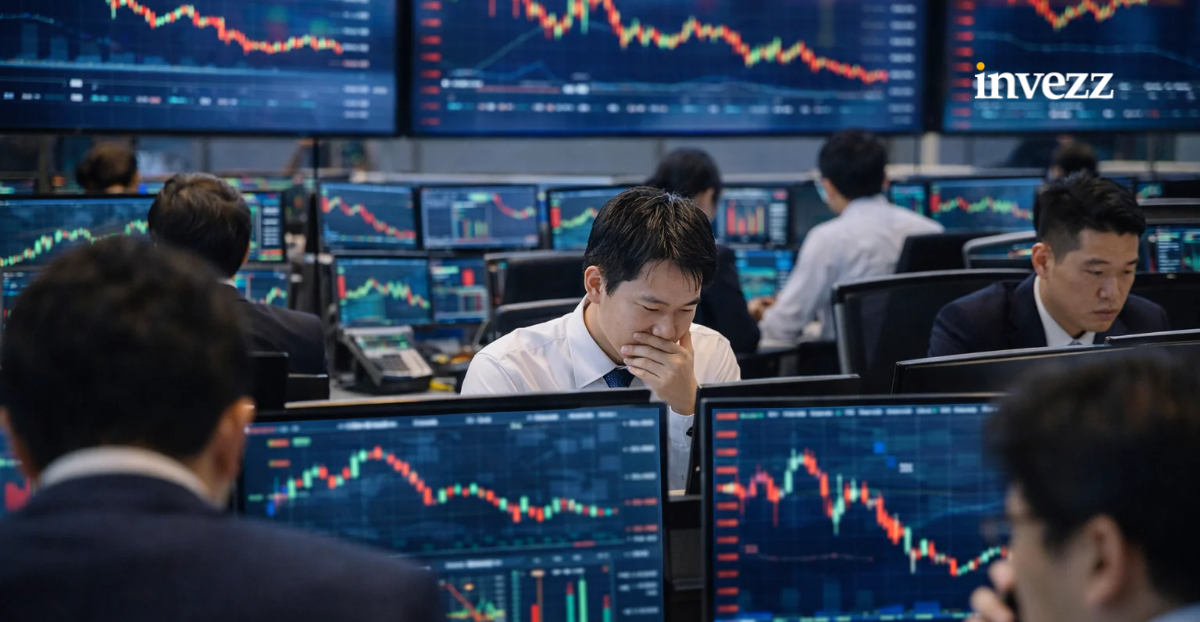
South Korean stocks tumbled on Monday as renewed selling in semiconductor shares overwhelmed government assurances that emergency support would be available if market conditions deteriorated further.
The KOSPI fell as much as 5.8% to 4,586.80 in intraday trading, following Friday’s 5.21% loss that left the benchmark at a 10-month closing low.
Finance Minister Lee Hyoung-il said authorities were preparing to intervene if necessary, but stopped short of announcing purchases through the country’s market-stabilization fund.
The rout underscores how concerns about AI valuations and tighter US technology restrictions are overshadowing expectations of solid Korean economic growth.
Samsung, SK Hynix stocks bear the brunt of AI selling
Samsung Electronics and SK Hynix led Monday’s chip stock sell-off, falling about 5.5% and 4.9%. Their heavy weighting in the benchmark makes declines particularly damaging to the wider market.
Investors are increasingly questioning whether the vast spending planned for AI data centres can sustain the earnings growth built into technology valuations. Tighter US rules governing access to advanced computing have added uncertainty for Asian suppliers.
The pressure has also been compounded by overseas selling. LSEG figures cited in recent market reporting show foreign investors heading for a seventh consecutive month of net Korean equity sales, with cumulative outflows of $115.2 billion.
Kiwoom Securities analyst Han Jiyoung has warned that the market needs a catalyst to bring foreign investors back despite strong corporate earnings.
KOSPI index today: Seoul readies a safety net without deploying it
Following an emergency meeting on Sunday, the government said it would complete preparations to activate its securities market stabilisation fund when conditions warranted.
Lee told reporters in Sejong on Monday that officials had additional contingency measures and would act according to market conditions.
Authorities also plan to relax daily limits on listed companies’ share buyback orders for three months from Tuesday, giving businesses greater flexibility to support their own shares.
Financial regulators will intensify monitoring of illegal short selling and market manipulation over the same period.
But Lee rejected calls for sweeping new short-selling restrictions, favouring stronger enforcement of existing rules. South Korea lifted its previous blanket ban in March 2025 after establishing a centralised detection system.
The distinction matters, as preparing financial firepower may reassure investors, but it is not the same as injecting capital into the market.
KOSPI crash: Strong economic forecasts clash with falling share prices
Lee still expects economic momentum to remain robust. He said growth could reach the upper-3% range in 2026 if current trends persist, and projected continued expansion next year.
The International Monetary Fund recently forecast growth of 3.9% this year and 3.3% in 2027, supported by semiconductor exports and investment.
However, for investors, near-term risk is taking precedence over those projections. Lee warned that volatility in AI-related industries could spill into the wider economy, while geopolitical uncertainty and higher global interest rates remained threats.
The next test is whether the government’s preparations can arrest selling without an actual fund deployment, or whether another decline forces Seoul to move beyond reassurance.
AI disclosure: AI tools assisted with research and drafting of this piece. An Invezz editor reviewed the facts, sources and wording before publication. Any opinions or analysis are Invezz’s, not those of an automated system.
The post Why is South Korea's KOSPI crashing despite a government rescue pledge? appeared first on Invezz