
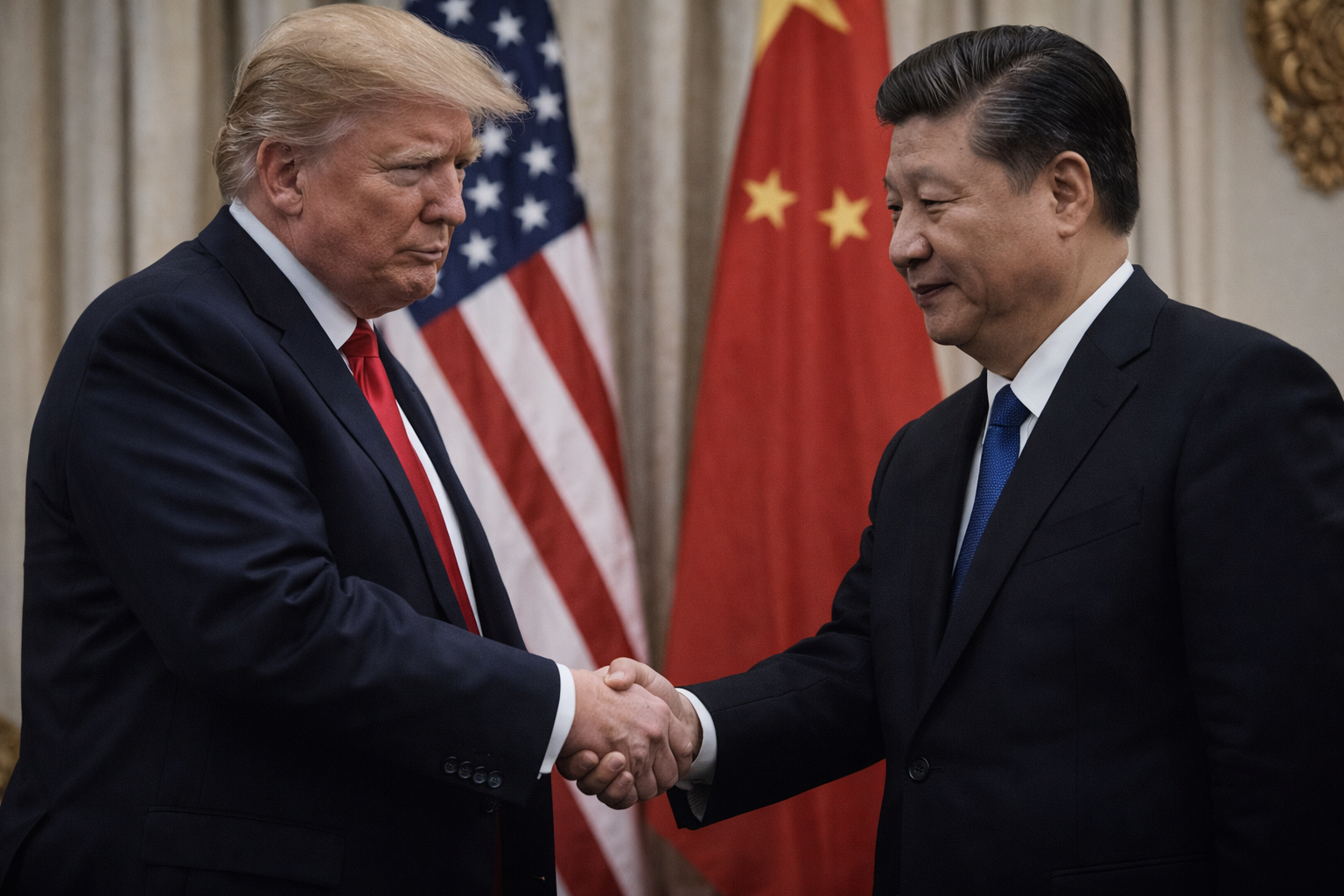
President Donald Trump is heading to Beijing with a business delegation that is heavy on marquee names and light on surprise.
Sixteen top executives are expected to join the Beijing visit, including Elon Musk of Tesla, Tim Cook of Apple, Kelly Ortberg of Boeing, Larry Culp of GE Aerospace, Larry Fink of BlackRock, Stephen Schwarzman of Blackstone, and David Solomon of Goldman Sachs.
The delegation also includes Jane Fraser of Citigroup, Cristiano Amon of Qualcomm, Michael Miebach of Mastercard, Ryan McInerney of Visa, Brian Sikes of Cargill, Jim Anderson of Coherent, Jacob Thaysen of Illumina and Sanjay Mehrotra of Micron Technology.
The summit itself is slated for May 14-15, and the mix of attendees already tells investors where Washington wants the conversation to land: aircraft, agriculture, finance and supply chains.
The deals already written before the plane lands
The first takeaway is that this trip is built around transactions that are largely pre-negotiated.
Boeing and China have been in prolonged talks over a deal that could include 500 737 MAX jets plus dozens of widebody aircraft, a package that would be China’s first major Boeing order since 2017 and potentially the largest airplane order in history.
Beijing is expected to announce purchases tied to American agriculture and energy, which helps explain why Cargill’s Brian Sikes is on the list.
In that sense, the delegation is commercial, and it is meant to surface tangible wins fast.
That framing is exactly why the White House kept the delegation narrower than past China visits.
The administration considered around a dozen companies, far fewer than the 29 executives who accompanied Trump in 2017, and the US Trade Representative Jamieson Greer was reluctant to make the trip look like a full-scale “managed trade” summit.
Reva Goujon of Rhodium Group told Reuters that “a small CEO delegation that aligns with the actual concessions and negotiating points would make sense,” adding that Greer seemed intent on not setting expectations too high.
Read more- Trump-Xi summit: trade, Taiwan, AI talks in focus; major breakthroughs unlikely
Who didn’t make the cut?
The names left off the list are as revealing as the ones on it.
Jensen Huang was not invited, as the White House was deliberately prioritizing agriculture and commercial aviation rather than semiconductors.
That makes sense politically as chips remain one of the most sensitive flashpoints in US-China relations, and the administration appears to want this summit to stay focused on deal flow, not export controls.
Oil and gas chiefs were absent from the invite list, with the global energy sector’s current strain from Iran-war-related disruptions likely pushed the White House towards a narrower roster.
The broader geopolitical backdrop matters as the Council on Foreign Relations says Trump and Xi are slated to meet in Beijing on May 14-15, and argues that the summit gives Beijing room to “manage” Washington while trade, Taiwan, rare earths and AI all hover in the background.
That is the key investor point: the White House is trying to extract visible commercial wins while sidestepping the tougher strategic issues that could derail the optics.
Absences such as Nvidia, Alphabet, GM and Disney therefore look less like personal slights than an effort to keep the agenda winnable.
The post Who's in, who's out: what Trump's China CEO list really signals? appeared first on Invezz