
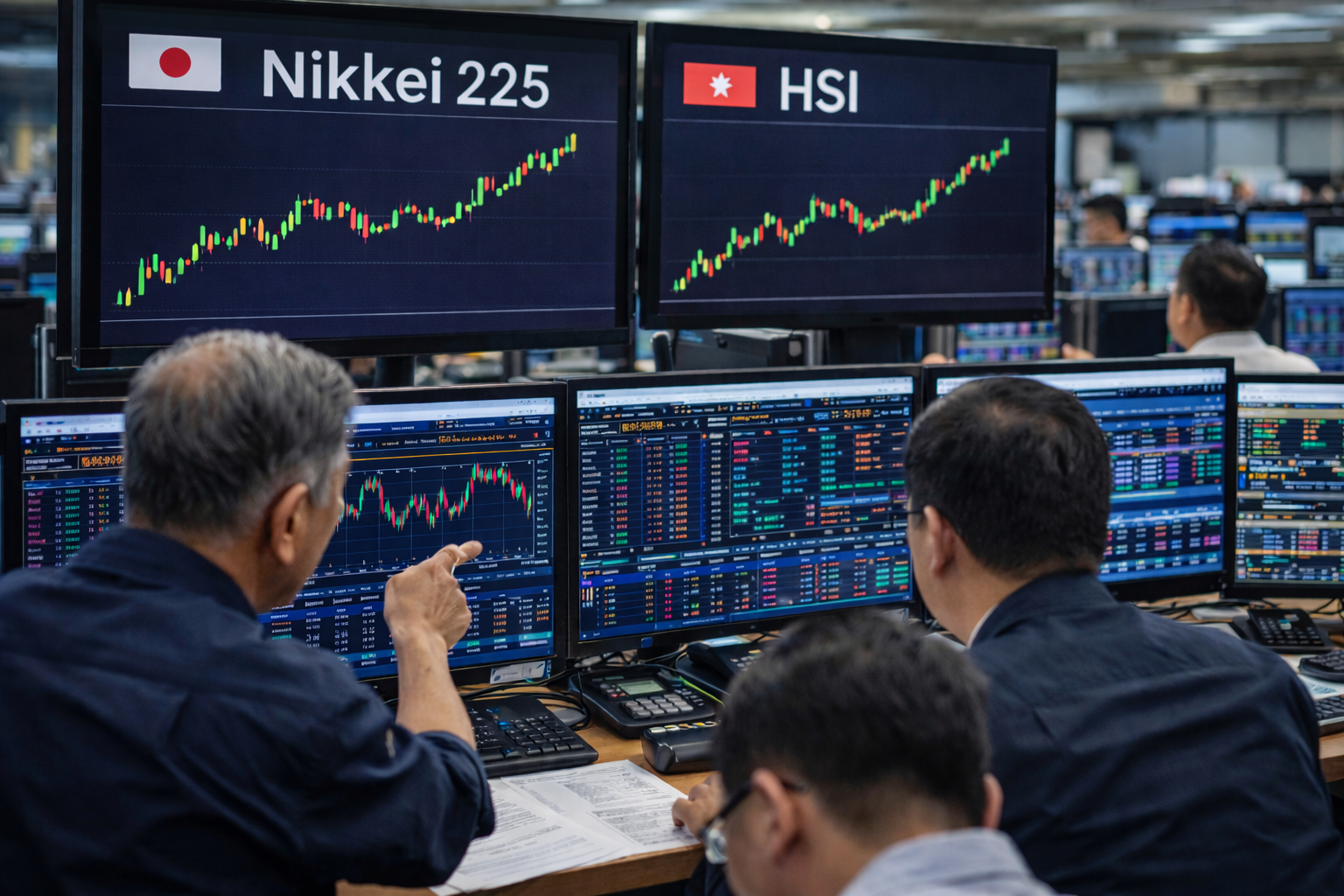
On Thursday, Asian stocks rebounded after steep losses, while bond yields climbed and energy prices rose amid the escalating conflict in the Middle East.
At the same time, bitcoin held firm near recent highs as institutional demand through exchange-traded funds continued to build.
Meanwhile, China unveiled a slightly lower economic growth target, and talks resumed between Anthropic and the US Department of Defense over the military use of artificial intelligence tools.
Asian markets rebound amid geopolitical uncertainty
Asian equities rallied Thursday, pointing to a tentative recovery in risk appetite after financial markets were rattled by the expanding war in the Middle East.
South Korea’s KOSPI surged 11.2%, recovering from a historic plunge in the previous session, while Japan’s Nikkei rose 2.5%.
MSCI’s broadest index of Asia-Pacific shares outside Japan jumped 3.9%.
The rebound followed gains on Wall Street, though analysts warned that the recovery may remain fragile.
At the same time, US Treasury yields moved higher as bond prices declined.
The yield on benchmark 10-year Treasury notes rose 3.9 basis points to 4.121%, while the 30-year yield climbed 4.4 basis points to 4.7607%.
Energy markets continued to react strongly to the conflict. US crude rose 3.94% to $77.60 per barrel, while Brent crude climbed 3.5% to $84.25.
Oil prices have gained roughly 16% since the start of the conflict, driven by concerns about potential supply disruptions.
Gold also moved higher, rising 0.78% to $5,175.47 an ounce.
Bitcoin holds near $72K as ETF inflows continue
Bitcoin remained supported by institutional demand, trading near $72,500 on Thursday.
US-listed spot bitcoin exchange-traded funds recorded another $155 million in net inflows on Wednesday, extending a recent run of institutional buying that has helped stabilize the market.
Total allocations to the funds have reached roughly $1.47 billion over the past two weeks, according to SoSoValue data.
Earlier this year, ETFs had experienced several weeks of outflows, but flows have since reversed.
Since February 24, investors have poured about $1.7 billion into US spot bitcoin ETFs, according to Bloomberg Intelligence data.
However, analysts caution that ETF inflows do not necessarily translate into immediate buying activity in the spot market.
On-chain data suggests caution.
Glassnode said buy-side momentum has weakened, with the 30-day moving average of realized profit falling about 63% since early February.
China sets lower growth target
China also drew investor attention after unveiling a new economic growth target for 2026.
The government set its goal at 4.5% to 5%, slightly below the 5% growth rate achieved last year.
The target was announced at the National People’s Congress during the country’s annual “two sessions” political gathering.
Premier Li Qiang’s work report outlined plans to support consumption, upgrade industry, and manage financial risks.
The strategy reflects the challenges facing China’s economy, including weak household spending, a prolonged property downturn, and rising geopolitical pressures.
China also released details of its upcoming 15th Five Year Plan, which emphasizes investments in innovation, high-tech industries, and scientific research, along with efforts to boost domestic demand.
Chinese equities reacted positively, with the CSI 300 rising 1.4% and the Shanghai Composite gaining 1%.
Anthropic resumes talks with Pentagon over AI contract dispute
Financial Times reported that talks between Anthropic and the US Department of Defense have resumed after negotiations over the use of artificial intelligence tools by the military collapsed last week.
Anthropic CEO Dario Amodei is now in discussions with Emil Michael, the under-secretary of defense for research and engineering, in what the FT described as a last-ditch effort to reach an agreement.
The talks had broken down after the Pentagon demanded that Anthropic’s AI models be available for any lawful military use, while the company sought assurances that its tools would not be used for domestic surveillance or autonomous weapons.
Claude, Anthropic’s flagship model, had previously become the first major AI system deployed in the US government’s classified networks under a $200 million Defense Department contract.
The dispute escalated when President Donald Trump directed federal agencies to stop using Anthropic’s tools and Defense Secretary Pete Hegseth said the company could be designated a supply-chain risk.
Amodei later told staff that Pentagon messaging surrounding the negotiations was “just straight up lies about these issues or tries to confuse them.”
Meanwhile, OpenAI signed a separate deal with the Defense Department, though CEO Sam Altman later acknowledged that the agreement may have been rushed.
The post Morning brief: Asian stocks rally; Bitcoin holds near $72K appeared first on Invezz