
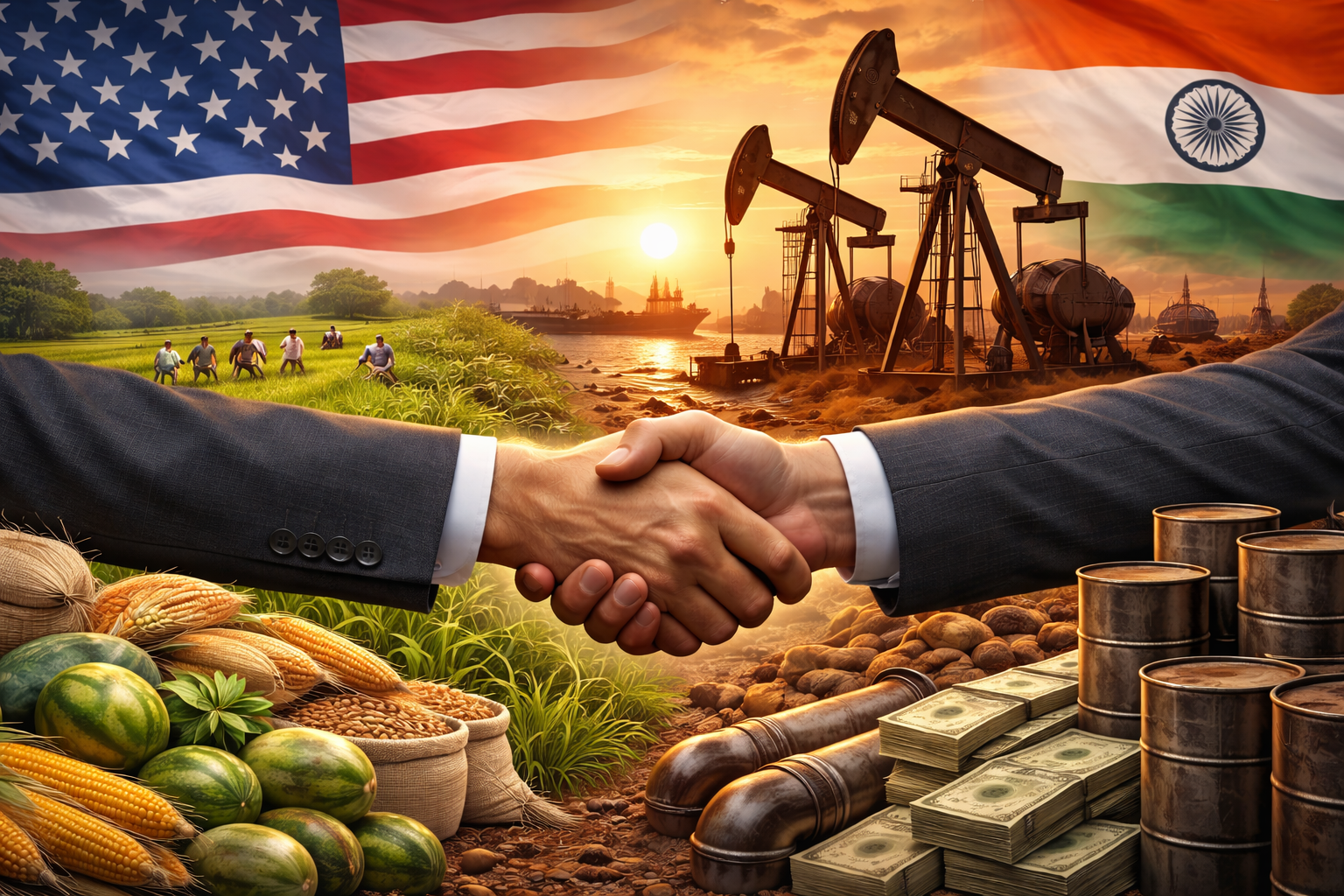
After months of speculation and stalled negotiations, India and the United States have announced a breakthrough in their bilateral trade talks, triggering optimism in financial markets but also reviving deeper questions about energy dependence and agricultural policy.
US President Donald Trump said tariffs on Indian goods would be reduced from 25% to 18%, while claiming that Prime Minister Narendra Modi had agreed to sharply scale down purchases of Russian oil and commit to buying more than $500 billion worth of US energy, technology, agricultural and coal products.
The announcement sent Indian equities sharply higher, with the Sensex rising more than 2,280 points and the Nifty 50 climbing over 700 points on Tuesday.
To be sure, the details of the deal are still awaited.
Yet analysts caution that the real economic impact will depend less on headline tariff cuts and more on how the unresolved issues around oil and agriculture are ultimately addressed.
Tariff relief lifts market mood
The tariff reduction has been welcomed by investors as a significant easing of trade tensions between the two countries.
Trideep Bhattacharya, president and CIO for equities at Edelweiss Asset Management, said the outcome had exceeded expectations.
“The reduction in tariffs from around 50% to around 18% has come in materially better than consensus expectations,” he said, adding that combined with the India–EU trade agreement, it could become one of the strongest external growth stimuli for India in 2026.
For markets, the deal provides clarity at a time when global investors have been cautious about emerging markets amid geopolitical uncertainty and volatile commodity prices.
But analysts argue that the headline numbers mask complex trade-offs that could shape India’s macroeconomic trajectory in the coming years.
Stark changes in Russian oil purchases could lead to higher inflation in India
One of the most contentious elements of Trump’s announcement is the claim that India has agreed to stop buying Russian oil and shift purchases toward the United States and other suppliers.
According to analysts, this aspect of the deal could have far-reaching implications for inflation, fiscal stability, and the current account.
“This is constructive for Indian equities because it reduces trade policy uncertainty and improves visibility for export-linked earnings,” said Charu Chanana, chief investment strategist at Saxo in Singapore.
“But there’s a lot we still don’t know. If the oil bill rises meaningfully, that can reintroduce inflation and currency sensitivity.”
Moody’s Ratings echoed similar concerns, noting that India is unlikely to abruptly end Russian crude purchases without economic disruption.
The ratings agency added that “a completely shift toward non-Russian oil could also tighten supply elsewhere, raise prices and pass through to higher inflation given that India is one of the world’s largest oil importers.”
Recent data shows that India has already begun gradually reducing its reliance on Russian crude.
Imports of Russian oil declined sharply in late 2025, with refiners cutting orders of Urals crude and some major players such as Reliance Industries halting purchases in early 2026.
Yet analysts say a complete exit from Russian oil would be difficult to achieve without significantly increasing costs.
The oil question, therefore, sits at the heart of the trade deal’s economic calculus.
While closer energy ties with the United States could strengthen strategic alignment, they could also expose India to higher import costs and greater vulnerability to global price swings.
Agriculture as the political fault line
If oil represents the economic challenge of the deal, agriculture represents its political fault line.
Trump has claimed that India would buy more than $500 billion worth of US energy, including coal, as well as technology — and agricultural products too.
His Truth Social post was followed by a post on X by US Agriculture Secretary Brooke Rollins, who said the agreement would expand exports to India’s vast consumer market, helping lift farm incomes and reduce the bilateral agricultural trade deficit.
Thank you @POTUS for ONCE AGAIN delivering for our American farmers.
New US-India deal will export more American farm products to India’s massive market, lifting prices, and pumping cash into rural America.
In 2024, America’s agricultural trade deficit with India was $1.3
“New US-India deal will export more American farm products to India’s massive market, lifting prices, and pumping cash into rural America. In 2024, America’s agricultural trade deficit with India was $1.3 billion. India’s growing population is an important market for American agricultural products and today’s deal will go a long way to reducing this deficit,” she said.
However, Indian negotiators have consistently maintained that agriculture is a red line in trade talks.
Protecting farmers has been presented as a non-negotiable priority, reflecting both economic realities and political sensitivities.
An unnamed Indian official told Reuters that agriculture would be included in the agreement but only in a limited manner, suggesting that the announcement represents an initial tranche rather than a comprehensive deal.
The stakes are high. Cheaper agricultural imports from the United States—where farming is large-scale, mechanised and heavily subsidised—could destabilise domestic crop prices in India.
With 86% of Indian farmers operating on small and marginal holdings, even modest shifts in import policy could have significant social and political consequences.
India has drawn firm red lines around dairy, rice, and wheat, resisting any move that could expose domestic producers to a surge of subsidised imports.
Dairy has been particularly sensitive, both for cultural reasons and because of its role in sustaining millions of small producers.
These constraints were among the key reasons why negotiations dragged on for months despite political pressure from Washington.
A deal still in motion
Commerce Minister Piyush Goyal has framed the agreement as a strategic opportunity for India, highlighting its potential to unlock access to US technology and global markets.
Yet his remarks notably avoided any explicit reference to large-scale agricultural imports, underscoring the ambiguity surrounding this aspect of the deal.
Analysts say the current announcement should be seen less as a final settlement and more as the beginning of a longer negotiation process.
The balance between strategic alignment with the United States and domestic economic priorities will ultimately determine whether the agreement becomes a durable economic partnership or a source of new tensions.
The post What does the India-US trade deal mean for oil and agricultural products appeared first on Invezz