
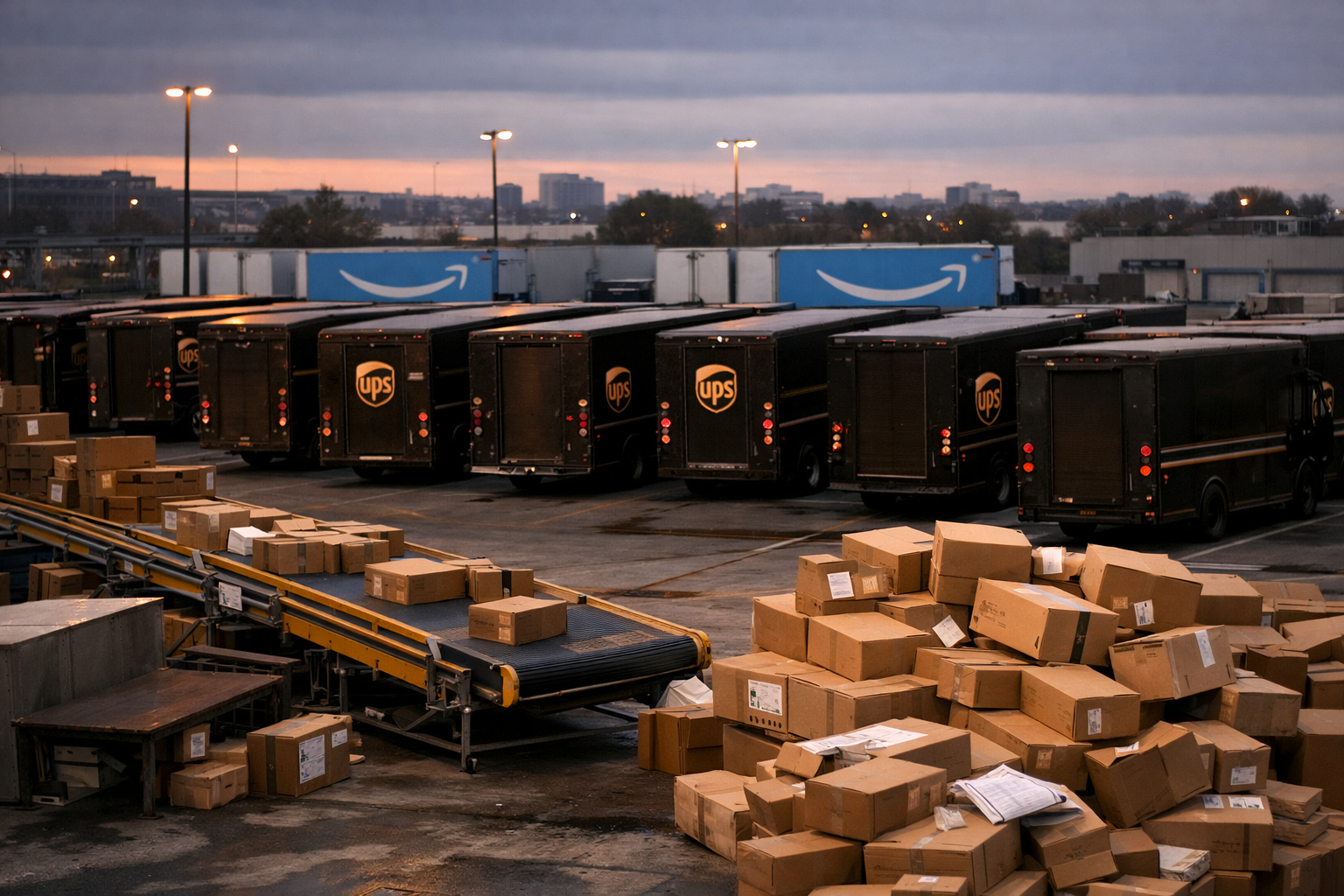
United Parcel Service is pressing ahead with a major restructuring that will see up to 30,000 jobs cut this year, underscoring how costly its separation from Amazon has become as competition intensifies in the US delivery market.
The move reflects a strategic shift by the world’s largest parcel carrier to reduce exposure to low-margin volumes while reshaping its network for a more competitive and fragmented logistics landscape.
While the workforce reductions point to continued pressure on costs, UPS has paired the announcement with a stronger revenue forecast, suggesting its reset is starting to change the shape of its business.
Amazon volumes rolled back
UPS has been steadily cutting back shipments for Amazon, its biggest customer, after concluding that the scale of the relationship was hurting profitability.
The company has previously said Amazon deliveries were extraordinarily dilutive to margins, prompting a multi-year effort to rebalance its customer mix.
That process began last year when UPS said it would deliberately reduce its dependence on Amazon as part of a broader turnaround plan.
The strategy involved prioritising higher-margin customers, including healthcare companies, while shrinking lower-value volume.
As Amazon shipments were scaled back, UPS cut 48,000 jobs and closed 93 facilities in 2025.
It has since confirmed plans to shut another 24 facilities in the first half of this year.
The latest job cuts are expected to be carried out through buyout offers to full-time drivers and by not replacing staff who leave voluntarily, rather than through compulsory layoffs.
Network reshaping continues
UPS says it is now in the final phase of an accelerated plan to reduce Amazon volume.
Over the full year 2026, the company intends to remove another million parcels per day from its Amazon business while continuing to reconfigure its delivery network.
According to its 2024 annual report, UPS employed about 490,000 people globally, with nearly 78,000 working in management roles.
The workforce is largely unionised, adding complexity to any restructuring programme, even when job reductions rely on voluntary exits.
Alongside staffing changes, UPS is also adjusting its asset base.
The company confirmed it is officially retiring its fleet of MD-11 cargo aircraft following a fatal crash in Louisville, Kentucky, in November.
The planes, which account for about 9% of the fleet, have remained grounded since the accident.
Earnings offer reassurance
Despite the scale of the restructuring, UPS reported revenue of $24.5bn for the final quarter of last year.
It also surprised markets by forecasting revenue of $89.7bn for the year ahead, pointing to early signs that the shift towards higher-margin customers may help offset the loss of Amazon volume.
UPS shares closed slightly higher in New York trading on Tuesday. The shares have gained by 0.19% after market hours.
Delivery market rivalry sharpens
The pressure on UPS is closely tied to the rapid expansion of Amazon’s in-house logistics network.
In recent years, Amazon has invested heavily in its own delivery capabilities, reducing its reliance on traditional carriers such as FedEx and the United States Postal Service.
In 2024, Amazon handled 6.3 billion deliveries in the United States, overtaking both UPS and FedEx by volume.
According to projections from Pitney Bowes, Amazon is expected to surpass USPS in total US delivery volumes by 2028.
For UPS, the rise of Amazon as both customer and competitor has forced a difficult recalibration.
The latest job cuts underline how deeply that recalibration is reshaping the company, even as the broader US delivery race continues to evolve.
The post UPS job cuts underline costly break with Amazon in US delivery race appeared first on Invezz